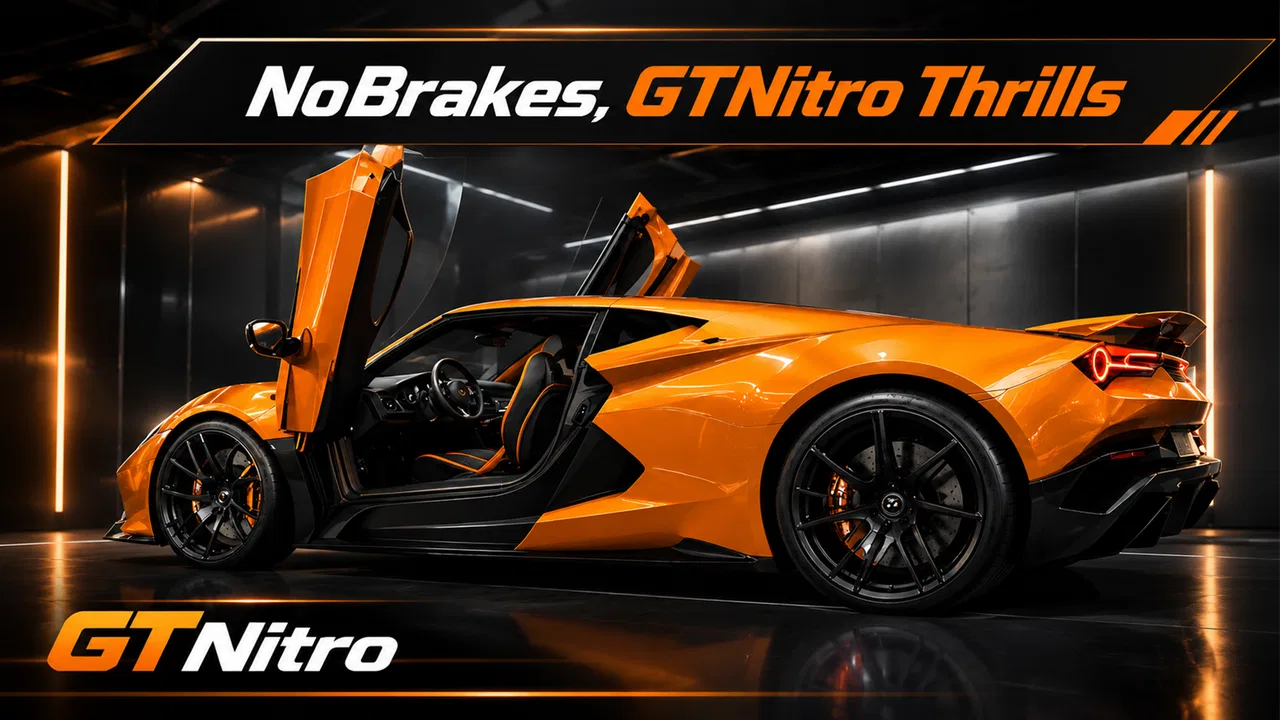
GT Nitro:Drag Racing Car Games
- 4.6
- Rating
- 10.00M
- Installs
- Free
- Price

 Analysis by App-foxy
GT Nitro:Drag Racing Car Games is the kind of racing game I can open for a few minutes and understand almost immediately. It focuses on short drag races rather than long circuits, so the main challenge is making the right launch and gear decisions before the finish line arrives. That simple structure makes it approachable for a first-time player, while the timing-based driving still gives experienced arcade racers something to improve.
I found it most enjoyable when I treated each race as a small test instead of expecting a full driving simulator. You are not steering through a complex city or learning a large open map. The attention stays on acceleration, shifting, and using the car’s boost at the right moment. If you like quick races with a clear result, this approach is easy to appreciate. If you want realistic handling, free exploration, or detailed multiplayer competition, you may find the experience more limited.
Starting with the right expectations
The game comes from Raya Games Limited and sits in the racing category as a free-to-play title. Its age rating is Everyone, which makes it a comfortable choice for younger players and families, although adults should still remember that optional purchases are part of the experience. The game has reached over ten million installs, and its average rating is 4.5 from around nineteen thousand ratings, so it has clearly found a sizeable audience among people who enjoy compact mobile racing sessions.
You May Also Like

 Blood Strike: 2.5 Anniversary
Blood Strike’s Loadouts Turn Every Drop Into a Tactical Gamble
A close look at Blood Strike’s custom loadouts: how fast access to signature weapons reshapes its battle royale rhythm, rewards preparation, and narrows the gap between fights.

 Pandora - Music & Podcasts
Pandora’s Music Is Easy to Start, but Harder to Recover
Pandora’s strength is its low-effort path from a seed to a station. Its weak spot is how much confidence it asks you to place in connection, setup, and quiet recovery.

 8 Ball Pool
 Is Built on Rivalries, Rematches, and Routine
A close look at the rivalries, rematches, shared routines, and unanswered safety questions that turn a quick pool match into a persistent mobile community.

 Samsung Music
’s Quiet Strength Is Playing What You Already Own
Its reach comes less from spectacle than from dependable access to a personal library. That simplicity is both the app’s strongest retention engine and its ceiling.

 AccuWeather: Weather Radar
AccuWeather Review: A Quick, Clear Forecast for Everyday Decisions
For everyday plans, the best forecast is the one you can understand quickly. AccuWeather makes rain timing, radar, and local conditions easy to act on, with a few trade-offs.

 Hill Climb Racing
Why Hill Climb Racing Still Turns Crashes Into One More Run
A tiny car, a bumpy hill and one more upgrade: Hill Climb Racing keeps resurfacing because its simple chaos makes every near-miss feel personal.
More From Our News Desk



What stood out to me first was how little time a race needs. This is useful when I am waiting for a bus, taking a short break, or simply want a quick change of pace without committing to a long championship. A single run can feel meaningful because the result depends on a few precise moments. That also means mistakes are easy to notice: a late shift or poorly timed nitro can decide the race almost instantly.
The central rhythm is straightforward. The car accelerates along a drag strip, and I concentrate on building speed, changing gears at useful moments, and activating the nitro boost when it can make a real difference. The appeal is not in memorizing a huge control scheme. It is in learning the timing well enough that the car feels increasingly responsive under my control.
That simplicity is both the game’s strongest quality and its main limitation. I never felt overwhelmed by controls, but I also did not get the variety I would expect from a traditional circuit racer. Games built around drifting, braking into corners, or exploring different routes offer more driving techniques. GT Nitro is better understood as a focused reaction-and-upgrade racing game than as a complete virtual garage or motorsport simulation.
The current version is 1.15.27 and the game can run on devices using Android 7.1 or later. For someone choosing a game for an older Android phone, that compatibility is useful, though actual smoothness can still depend on the device. I would install it with the expectation of a lightweight arcade-style session, not the visual and technical demands of a console racing game.
The first setup and what I would check
Because the game is free to install, the first decision is not whether to pay before trying it. The more important choice is how much attention I want to give its progression. In-app purchases range from $0.49 to $94.99 per item, so I would treat the purchase options carefully and avoid tapping through them automatically. A free starting point is enough to decide whether the racing loop suits you.
On my first launch, I would keep the opening session focused on learning rather than spending. The best early goal is not to build the most impressive garage immediately; it is to understand how the car reacts to acceleration, gear changes, and nitro. That knowledge remains useful even if you later decide to improve the vehicle, while an early purchase cannot replace poor timing.
I also recommend playing the first few races with sound at a comfortable level, if your surroundings allow it. Audio cues can help you notice the rhythm of acceleration and shifting, but I would not rely on sound alone. Visual timing matters more when you are in a noisy place, and building a visual habit makes the game easier to play during a commute or in a shared room.
One practical tip is to hold off on changing too many things at once. If you alter the car and immediately change your racing technique, it becomes difficult to tell what actually improved the result. I prefer to run a few races with the same approach, identify whether the problem is the launch, shifting, or boost timing, and then make one adjustment. That turns the early game into a simple experiment instead of random tapping.
The free-to-play structure also affects how I would recommend the game to a child. The Everyone rating makes the content broadly accessible, but the purchase range means device-level purchase controls are worth considering. The game itself is easy to understand; the more important family habit is making sure a child knows that optional items are not required for every race.
How I reached the first meaningful success
For a new player, the first satisfying milestone is not simply completing a race. It is winning because your timing improved. I would begin by watching the car’s acceleration closely and learning the point at which a gear change helps rather than hurts. Early on, it is tempting to tap repeatedly or react in a panic. A calmer rhythm usually gives better results than frantic input.
Nitro deserves separate attention. I found it more useful when treated as a planned part of the run instead of an emergency button. Using it immediately may feel exciting, but it can waste the advantage if the car has not built enough speed or if the boost would be more valuable near the final stretch. I would test different moments across several races and remember which timing produces the clearest improvement.
The quickest path to a first real win is consistent timing, not early spending. That is an important distinction in a game built around short races. If you lose, ask one specific question: did the run fail at the start, during a shift, or when the nitro was used? Focusing on one mistake at a time makes progress easier to see and keeps the game from feeling arbitrary.
A realistic everyday scenario is a five-minute break between tasks. I can play a race, notice that my shift was late, try again with a more deliberate rhythm, and finish with a clear lesson. That loop works better for me than a game that requires a long uninterrupted session. It also makes the title suitable for players who prefer small, repeatable challenges rather than lengthy campaigns.
Another useful habit is to avoid judging the car after a single poor run. Drag racing leaves little room for recovery, so one mistimed action can make the vehicle appear weaker than it really is. I would repeat the same race with the same setup before deciding that an upgrade or a different approach is necessary. This is especially helpful for new players who might otherwise assume that every loss is caused by the car.
Where new players can become confused
The biggest source of confusion is the difference between a simple control scheme and a simple skill curve. The game is easy to start, but winning consistently still requires attention. A player may understand what the buttons do and yet lose because the timing is slightly off. That is not a complicated rules problem; it is a precision problem, and the solution is practice rather than searching for more controls.
It is also easy to mistake speed for progress. A stronger-looking car can help, but improvements do not remove the need to shift and boost well. If I spend too much time chasing upgrades without improving my timing, the result can be disappointing. Conversely, a player with good rhythm may get more value from the same vehicle than someone who simply taps through races.
Another point worth keeping in mind is that drag racing does not test the same skills as a normal track racer. There are no long corners here for learning racing lines, and the game does not give me the same sense of route choice that I get from circuit-based alternatives. If your idea of racing involves braking late, taking a hairpin, or finding shortcuts, this focused format may feel repetitive.
On the other hand, players who dislike steering controls may appreciate the reduced mental load. I can concentrate on launch and acceleration without constantly correcting a car’s direction. That makes GT Nitro a better fit than a traditional mobile racer for someone who wants the excitement of cars but not the frustration of virtual steering.
The purchase system is another area where I would slow down. Since items can cost from $0.49 up to $94.99, I would not assume that every offer represents good value for my personal play style. I would first decide whether I enjoy repeating races with the starting progression. If the core loop is not satisfying without purchases, buying more content or power is unlikely to fix that basic mismatch.
There is also a difference between playing casually and trying to optimize every run. Casual players can enjoy the immediate feedback of short races, while perfectionists may start noticing the narrow windows for ideal actions. I like that the same race can serve both groups, but the experience becomes less relaxed when every small mistake feels like a reason to restart.
How it compares with other mobile racing choices
Compared with a circuit racer, GT Nitro is faster to understand and easier to fit into a short session. I do not need to learn a track layout or manage several corners before I can tell whether I am improving. The trade-off is variety: circuit games usually offer more ways to express skill, while this game keeps returning me to acceleration, shifting, and boost timing.
Compared with an open-world driving game, it is much more focused. There is no need to spend time traveling between events or exploring a large environment before reaching the action. That is a strength when I want an immediate race, but a weakness if discovery and free driving are the main reasons I play racing games.
Compared with a realistic simulator, the controls are more welcoming and the races are less demanding in terms of vehicle handling. I would recommend the simulator route to someone who cares about braking points, traction, detailed setups, and authentic driving behavior. I would recommend GT Nitro to someone who wants a readable arcade challenge that can be learned in short attempts.
It also differs from drifting-focused games. Drifting titles reward angle control and sustained slides, whereas this game puts more emphasis on straight-line timing. That makes it a useful change of pace for players who enjoy cars but are tired of correcting a slide around every corner. It will not replace a drift game for someone who wants expressive cornering, though.
The most important comparison is therefore about attention span. If you want a game that delivers a complete race quickly, the format works well. If you want a deep long-term racing hobby with many driving disciplines, you may eventually want to pair it with another title rather than expecting it to cover everything.
Who should try it and who should skip it
I would suggest this game to first-time mobile racers, players who enjoy reaction-based challenges, and anyone who wants a quick car game without a complicated control layout. It is also a reasonable choice for families looking for an accessible racing title, provided optional purchases are handled sensibly. The broad age rating and free entry make trying it straightforward.
I would be more cautious about recommending it to someone who needs offline certainty, deep customization, or a realistic sense of driving. Those expectations belong more naturally to other racing formats. I would also suggest skipping it if repeated short races feel monotonous to you, because the focused drag-racing structure is the identity of the game rather than a small part of a larger driving world.
For competitive-minded players, the key question is whether improving timing is satisfying enough on its own. I enjoyed the feeling of turning a messy run into a cleaner one, but players who need extensive track variety or a large range of race types may want more depth. The game’s strength is concentration, not breadth.
My next-step routine after the first win
After getting a first meaningful win, I would not immediately rush through every available option. I would repeat the race once or twice and see whether the result was reliable. If it was, I would move forward while keeping the same deliberate approach: identify the launch rhythm, make gear changes with purpose, and reserve nitro for the moment that gives the run the best chance of finishing strongly.
When progression becomes harder, I would first review technique before assuming that spending is necessary. A small improvement in timing can be more satisfying and more sustainable than buying a shortcut. If the game presents an upgrade choice, I would choose based on the weakness I can actually identify rather than selecting the most expensive-looking option.
I would also use short sessions intentionally. Two focused races can be more useful than ten distracted attempts, especially when I am still learning the timing. If I start tapping without watching the car’s response, I take that as a sign to stop rather than continuing out of frustration. This keeps the game in its best role: a quick, repeatable challenge.
Overall, GT Nitro:Drag Racing Car Games works for me as a compact arcade racer with a clear first step and a manageable learning curve. Its best quality is the direct connection between a small timing improvement and a better finish. It is free to start, accessible to a wide age range, and established enough to have attracted over ten million installs, but its optional purchases and focused format deserve a realistic look.
I would recommend it to a friend who wants short drag races, simple controls, and a reason to replay the same style of challenge until the timing feels right. I would not present it as a replacement for a full racing simulator or an open-world car game. For the right player, though, it offers a reassuring path from the first launch to the first win: learn one action, improve one mistake, and let the finish line show the difference.
FAQs for GT Nitro:Drag Racing Car Games
01What platforms is GT Nitro: Drag Racing Car Games available on?
GT Nitro: Drag Racing Car Games is available for both Android and iOS platforms. You can download it from the Google Play Store for Android devices and the Apple App Store for iOS devices. Ensure your device meets the minimum system requirements for an optimal gaming experience.
02Are there in-app purchases in GT Nitro: Drag Racing Car Games?
Yes, GT Nitro: Drag Racing Car Games offers in-app purchases. Players can buy various upgrades, cars, and customization options to enhance their gameplay. While you can enjoy the game for free, purchasing items can provide a competitive edge and enhance your racing experience.
03What are the main features of GT Nitro: Drag Racing Car Games?
The game offers a variety of features such as realistic physics, a wide range of customizable cars, engaging drag racing challenges, and intensive multiplayer modes. Players can compete in real-time races, upgrade their vehicles, and experience dynamic weather conditions that add to the excitement.
04Is an internet connection required to play GT Nitro: Drag Racing Car Games?
While GT Nitro: Drag Racing Car Games offers some offline gameplay options, a stable internet connection is required for certain features like multiplayer races, leaderboards, and syncing progress across devices. Playing online ensures you have access to all the latest updates and community features.
05How can I improve my performance in GT Nitro: Drag Racing Car Games?
To improve your performance, focus on upgrading your car's engine, tires, and nitro boost. Mastering the perfect start and shifting gears at the right time are crucial for winning races. Participating in challenges and practicing regularly will also help in honing your racing skills.
Pros
- Intuitive controls enhance gameplay experience.
- Stunning graphics with realistic car details.
- Wide variety of cars to customize and race.
- Challenging races keep players engaged.
- Frequent updates with new content and features.
Cons
- In-app purchases can be quite expensive.
- Requires constant internet connection.
- Ads can be intrusive during gameplay.
- Limited offline gameplay options.
- Some cars locked behind paywalls.

GT Nitro:Drag Racing Car Games
Gallery